


What to do in Dusseldorf? Our best tips for spending 3 wonderful days.


What to do in Dusseldorf during a three-day city break? Discover our favourite places in Düsseldorf, from the Altstadt and striking modern architecture to Little Tokyo, art, Altbier and relaxing wellness by the water.
If you mainly know Düsseldorf for its airport, shopping streets or Christmas markets, you are missing a large part of the story. During our three-day city break, we discover a city that proves far more diverse than expected. Historic breweries sit within walking distance of spectacular contemporary architecture, a remarkable art space is hidden beneath the Rhine promenade, and in Little Tokyo you suddenly feel as though you have stepped into Japan.
Düsseldorf also knows how to surprise when it comes to food and drink. We taste local mustard and Killepitsch, enjoy fresh fish at Carlsplatz, discover why locals are so proud of their Altbier and end our first day with Japanese dishes on a rooftop.
And after two days filled with art, culture, gastronomy and thousands of steps? A Balinese wellness oasis by the Elbsee awaits.
What to do in Dusseldorf? Quite a lot, as it turns out. Join us for three surprisingly varied days in the city.
Table of content
Day 1: Carlsplatz, the Altstadt and modern architecture
Start your city break at Carlsplatz
Bäckerei Hinkel: dozens of breads to choose from
Taste Düsseldorf’s famous mustard
Düsseldorf from above: the Rheinturm
MedienHafen: architecture as an open-air museum
Day 2: Düsseldorf from the water, art and Altbier
KIT: art hidden beneath Düsseldorf
Museum-hopping with the Art Museum Pass
What to do in Düsseldorf? Taste the local Altbier
Traditional German food at Im Goldenen Kessel
Asphalt Festival at Schwanenspiegel
Day 3: Wellness at Vabali Spa Düsseldorf
Pure Relaxation with the Vabali treatment
Where to Stay in Düsseldorf: Henri Hotel
Is Düsseldorf worth visiting for a city break?
Frequently asked questions about Düsseldorf
How many days do you need in Düsseldorf?
Is Düsseldorf good for a city break?
What should you definitely see in Düsseldorf?
Where can you eat well in Düsseldorf?
Where can you drink Altbier in Düsseldorf?
Is Little Tokyo in Düsseldorf worth visiting?
When is the best time to visit Düsseldorf?
Day 1: Carlsplatz, the Altstadt and modern architecture
Our first introduction to Düsseldorf begins exactly the way we like to get to know a city: at the market.
Start your city break at Carlsplatz
Right in the city centre, Carlsplatz is a lively market where locals shop for groceries, people from the neighbourhood stop by for lunch and you can taste your way from one stall to the next.
Fruit and vegetables are sold alongside flowers, cheeses, delicacies, fish and dishes from around the world, giving the market the feel of a welcoming open-air food hall. We do not have to think long about lunch.
At one of the stalls, we choose a sandwich with young herring and another with delicious steamed salmon and vinaigrette. A little later, the pastries catch our eye too, so we finish with a refreshing lemon tart and a cappuccino.
No elaborate restaurant, just the kind of simple local experience we love to begin a city break with.
Stroll through the Altstadt
From Carlsplatz, we continue into Düsseldorf’s Altstadt.
The city began as a small settlement on the River Düssel and gradually developed into an important urban centre. Today, its historic heart is compact and easy to explore, with atmospheric streets and squares lined with cafés, restaurants and traditional addresses.
But while wandering through the Altstadt, it is worth looking beyond the terraces.
On Marktplatz, for example, you will find the equestrian statue of Jan Wellem, the nickname of Elector Johann Wilhelm II, who played an important role in the development of the city.
A little further on, the tower of St Lambertus Church is noticeably twisted. According to the official explanation, wet timber warped after a lightning strike. The local legend is far more entertaining: the tower is said to have turned away in shame after a bride falsely claimed she was still a virgin.
Düsseldorf has plenty more stories like that.
Bäckerei Hinkel: dozens of breads to choose from

One of our favourite stops in the Altstadt is Bäckerei Hinkel.
The bakery has been around since 1891 and is now run by the fourth generation of the same family. If you think bread is just bread, this is the place to change your mind.
Hinkel sells dozens of different varieties, made with ingredients such as spelt, barley, olives, spinach, sheep’s cheese, pepperoni and even liquorice. At busy times, the queue stretches out onto the street.
We sample a chocolate and caramel biscuit made in the bakery’s own workshop.
Taste Dusseldorf’s famous mustard
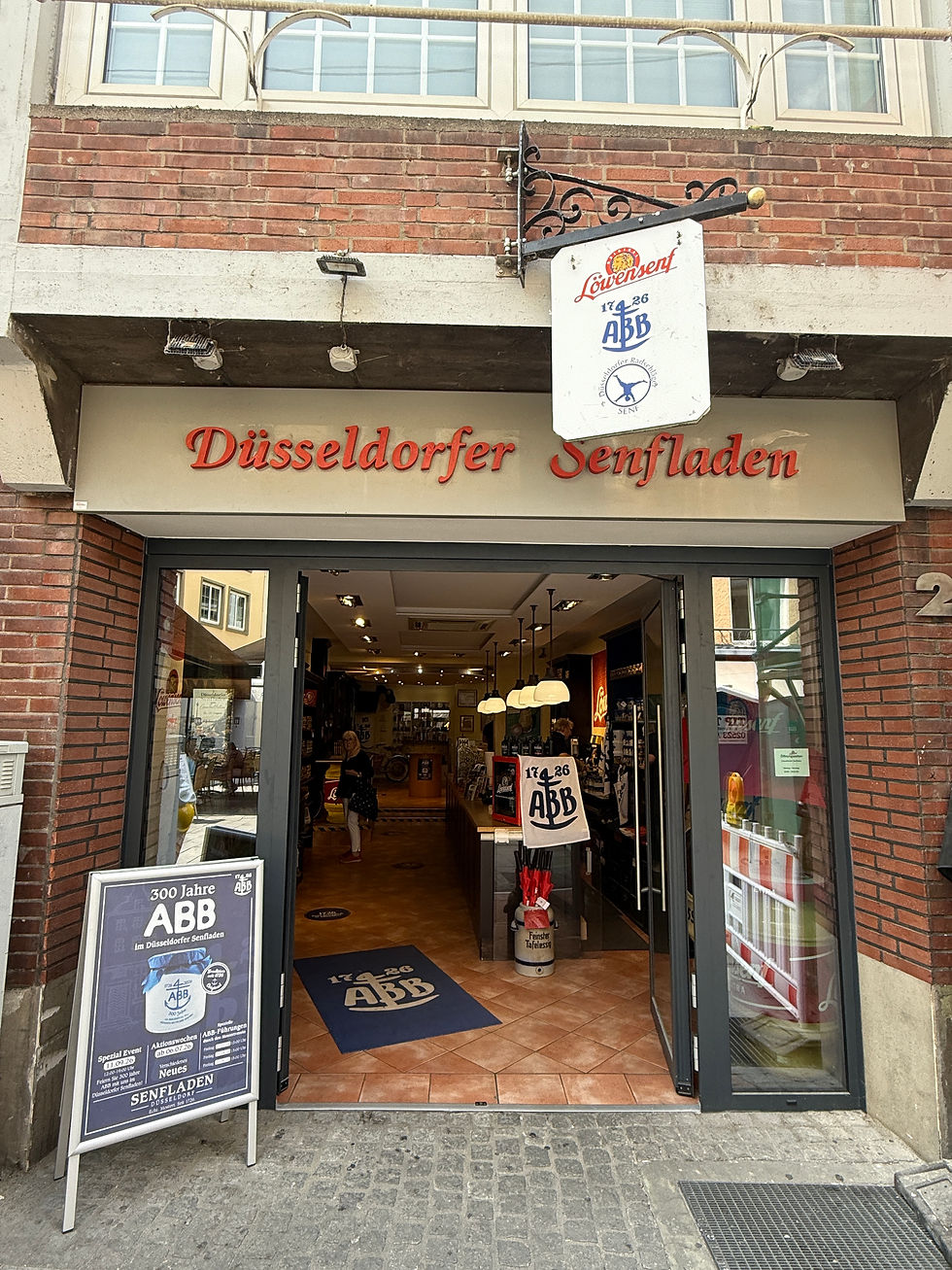
Just a couple of streets away, we discover another typically local product: Düsseldorf mustard.
Inside a tiny shop, the shelves are lined with the familiar grey stoneware jars bearing the blue letters ABB. The initials refer to Adam Bernhard Bergrath, who was already producing mustard here in the 18th century. We get to taste several varieties.
Our favourites are the red wine and plum mustard, along with the honey and dill version.
What we love about places like this is that you not only discover a local speciality, but also take a little piece of Düsseldorf home with you.
Killepitsch: the local remedy
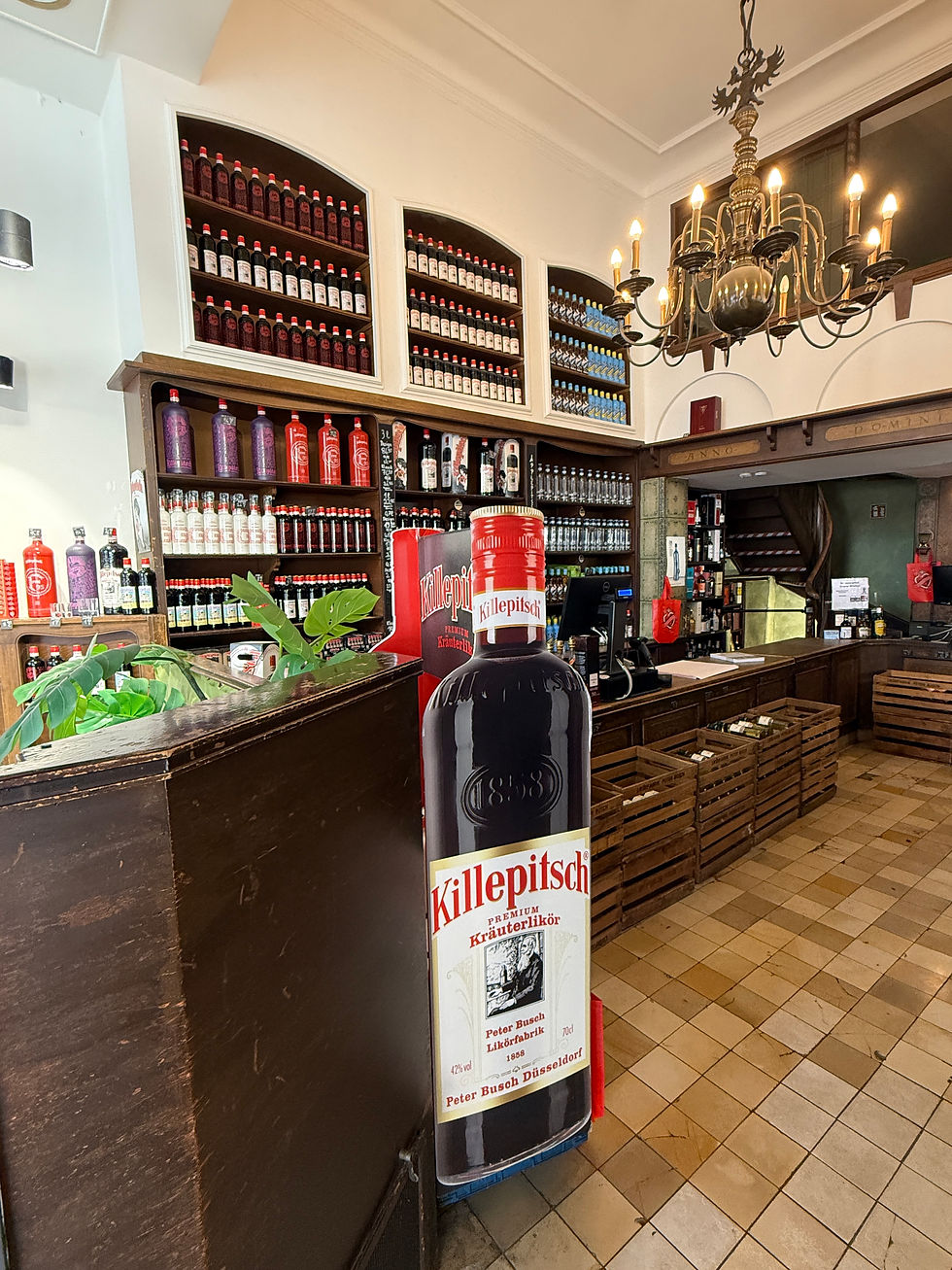
And then there is Killepitsch.
This famous Düsseldorf herbal liqueur is said to have originated from a promise made between two friends during the Second World War. While sheltering from an air raid, one of them vowed that if they survived the war, he would create a new schnapps. That promise was eventually fulfilled in 1955.
Killepitsch is made with no fewer than 98 herbs, berries and fruits, and has an alcohol content of 42%.
The most fun place to try it is Et Kabüffke on Flinger Straße, where the liqueur is served through a tiny hatch in the window. Bittersweet, herbal and decidedly strong.
According to the locals, it is not alcohol but medicine. Who are we to argue?
Dusseldorf from above: the Rheinturm
After all that tasting, we want to see Düsseldorf from a completely different perspective.
We make our way to the Rheinturm. From the panoramic viewing platform, you can see almost the entire city. Below, the Rhine curves broadly through Düsseldorf; on one side, you can pick out the towers of the Altstadt, while nearby stand the state parliament and the striking buildings of MedienHafen.
For us, this is the perfect place to really understand Düsseldorf for the first time.
From above, you see just how compact the historic centre is, how much space the Rhine occupies and how strongly modern architecture has reshaped the cityscape. Our next stop lies quite literally at our feet.
MedienHafen: architecture as an open-air museum
MedienHafen is one of the places that surprises us most. Where an industrial harbour once stood, you now find a fascinating collection of contemporary architecture. Old harbour cranes remain in place between modern office and residential buildings, so the history of the area never feels completely erased.
The best-known ensemble is undoubtedly Frank Gehry’s Neuer Zollhof. The three buildings almost seem to move. One is white, another clad in gleaming metal, and the third finished in red brick. The metallic building in particular immediately reminds us of Gehry’s Guggenheim Museum in Bilbao.
But MedienHafen has much more to offer.
The colourful Colorium, the striking architecture of Fumihiko Maki and buildings by Renzo Piano turn the district into something close to a free open-air architecture museum.
There is no need to rush from one building to the next. Simply wander around, look up and let the architecture surprise you.
Dinner in Little Tokyo
From modern German architecture, we head to Japan for the evening. Düsseldorf is home to a large Japanese community, and around Immermannstraße a district has developed that is now known as Little Tokyo. Here you will find Japanese supermarkets, bookshops, coffee bars, bakeries and, above all, plenty of restaurants.
We choose Takumi Kitchen, which is set in a particularly unusual location. We take the lift up to the Sky Lounge, a rooftop terrace on the eleventh floor. Here, we enjoy dishes including takoyaki, ramen and teriyaki while Düsseldorf slowly shifts into evening light below us.
The contrast with our lunch at Carlsplatz could hardly be greater. And that is exactly what we like so much about Düsseldorf.
Day 2: Dusseldorf from the water, art and Altbier
Our second day begins once again by the Rhine. Yesterday, we saw Düsseldorf from above; today, we want to experience the city from the water.
Take a boat trip on the Rhine
A boat trip on the Rhine offers a completely different perspective on Düsseldorf. From the water, the Rhine promenade, the Rheinturm and the striking buildings of MedienHafen come into view once again. What stands out most is the strong connection between the city and the river.
Yet it has not always been this way.
Until a few decades ago, a busy road ran along the river, effectively cutting the Altstadt off from the waterfront. The traffic was moved underground, and a broad promenade was created above the tunnel. Today, people walk and cycle along the Rhine, the terraces are full, and it feels as though the city has always been this open to the water.
KIT: art hidden beneath Dusseldorf
One of the city’s most surprising exhibition spaces emerged almost by accident from that same tunnel construction. KIT – Kunst im Tunnel is located beneath the Rhine promenade, between the two road tunnels. We enter through a glass pavilion and descend into a long, narrow gallery. While cars race past just a short distance away, down here there is almost complete silence.
During our visit, the annual Asphalt Festival is also taking place.
At KIT, we visit the photography exhibition Verschwinden (ARCHIV) by photographer Laurenz Berges. And we are given a unique opportunity: the artist himself guides us through the exhibition. Berges photographs abandoned places in North Rhine-Westphalia, some of which have since disappeared entirely. He works exclusively with natural light and avoids staging his images.
As we walk through the exhibition together, he explains why certain places attract his attention and what lies behind the photographs. An exhibition takes on a whole new dimension when the artist himself tells the story.
Museum-hopping with the Art Museum Pass

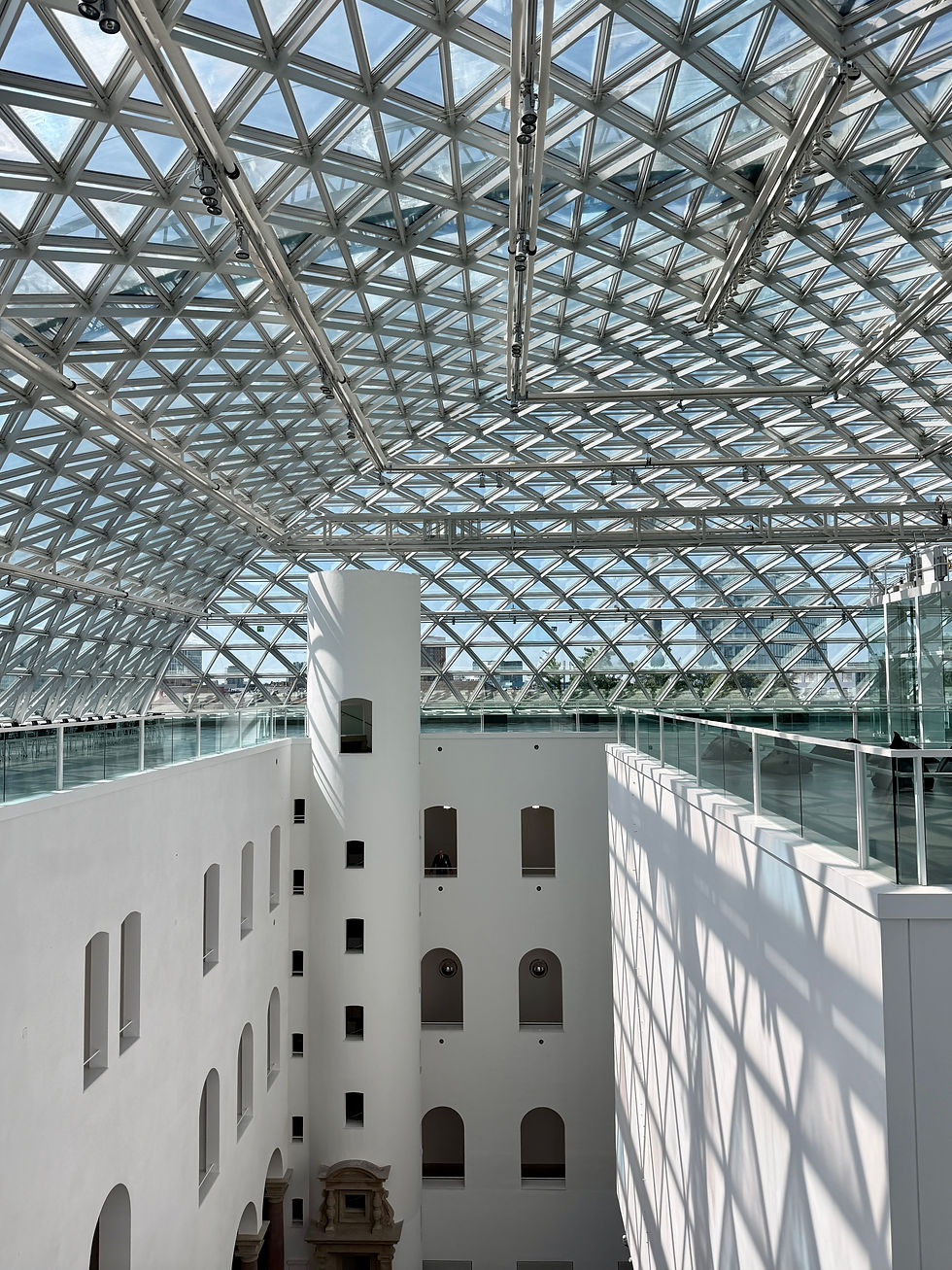
Dusseldorf has a surprisingly extensive art scene. With our Art Museum Pass, we have access to several museums across the city for 48 hours.
K21 in particular makes an impression. The museum is housed in the former Ständehaus, once used as a parliamentary building. The combination of historic architecture and contemporary art is already worth the visit. Above the building, a large glass dome creates yet another striking meeting point between old and new.
If you enjoy museums, Düsseldorf makes it easy to spend an entire day immersed in art. But we still have another form of local culture on the programme: Altbier.
What to do in Dusseldorf? Taste the local Altbier
Visiting Düsseldorf without drinking Altbier is almost impossible. So we head out with a guide to do it properly. Several traditional house breweries are within walking distance of one another in the Altstadt. Our route takes us to Uerige, Zum Schlüssel, Kürzer and Schumacher, among others.
And no, Altbier does not simply mean “old beer”. The name refers to an older brewing method using top fermentation.
Although the small glasses may look very similar at first glance, the flavours are noticeably different. At Uerige, the beer is darker with a more pronounced malty character. Zum Schlüssel is somewhat softer. Kürzer is a younger brewery, while at Schumacher we discover one of Düsseldorf’s great classics.
Traditional German food at Im Goldenen Kessel
Our beer walk ends at Im Goldenen Kessel, which is connected to Schumacher.
After several glasses of Altbier, a hearty German meal is exactly what we need.
I choose a schnitzel with paprika sauce, naturally accompanied by a glass of Schumacher Alt.
The way the beer is served is part of the experience too. In Düsseldorf’s traditional breweries, the Köbesse move between the tables carrying trays filled with small glasses of Altbier. A Köbes is the typical waiter in a Düsseldorf brewery, known for a direct, sometimes slightly gruff, but often humorous style of service. When your glass is empty, a fresh one will usually appear in front of you before you have even asked for it.
It is no coincidence that the Altstadt is often described as the longest bar in the world. Within a relatively compact area, hundreds of cafés, bars and restaurants sit side by side.
Asphalt Festival at Schwanenspiegel
In the evening, we swap beer for culture once again.
During our visit, the Asphalt Festival is taking place, an annual event that transforms unusual locations across Düsseldorf into performance spaces. Tonight, we find ourselves at the Schwanenspiegel.
A stage floats on the pond. The audience takes a seat along the shore and receives a pair of headphones. As evening falls, the Austrian group ELSA performs out on the water.
The music reaches us directly through the headphones while dragonflies skim across the surface and a heron appears among the reeds. A concert in the middle of a pond, surrounded by greenery yet still close to the city centre. It is one of those unexpected travel moments you do not forget easily.
Day 3: Wellness at Vabali Spa Düsseldorf
After two full days of walking through the city, it is time to discover a completely different side of Düsseldorf.
We drive about fifteen minutes outside the city centre towards Elbsee.
This is where you will find Vabali Spa Düsseldorf. The moment we step inside, Germany suddenly feels very far away.
A Balinese Oasis by Elbsee

The large wellness complex is inspired by Bali. Wooden statues, decorative gates and other elements were even brought directly from the Indonesian island. Combined with the lush greenery, relaxation areas and views over the lake, they create an atmosphere that makes you slow down almost instantly. After two busy days in the city, that is exactly what we need.
We try several saunas and steam rooms and enjoy a variety of sauna rituals.
The Seesauna is a particular favourite. Through its large windows, you look straight out over Elbsee. In the Kerzensauna, a peppermint infusion fills the room with a refreshing scent, and we also try a salt scrub, exfoliating our skin with coarse salt.
In between, there is really only one important activity: doing absolutely nothing.
Pure Relaxation with the Vabali treatment
There is no need to leave the spa for lunch either. Afterwards, one more indulgent moment awaits: the Vabali treatment massage.
With warm oil and slow, soothing movements, the last tension disappears from our legs.
After the massage, we are advised to let the oil absorb into the skin for another twenty minutes.
No hardship there. We find another quiet spot overlooking the water and decide that ending a city break with a wellness day is actually a very good idea.
After two days filled with culture, architecture and gastronomy, this third day feels like pure luxury.
Good to know: Vabali Spa Düsseldorf is textile-free. Keep this in mind when planning your visit.
Want to make a reservation? Check this link.
Where to Stay in Düsseldorf: Henri Hotel
During our city break, we stay at Henri Hotel Düsseldorf. The hotel has a distinctive vintage look, yet still feels surprisingly homely. The communal spaces invite you to linger a little longer, and the interior has far more personality than a typical business hotel.
For us, it is exactly the kind of place you are happy to return to after a busy day of exploring. Its location also makes it a convenient base for discovering Düsseldorf.
In our view, Henri fits the city perfectly: stylish, slightly quirky and just a little different from what you might expect.
Is Düsseldorf worth visiting for a city break?
Before this trip, we mainly associated Düsseldorf with its airport, shopping streets and Christmas market. After three days, we see the city very differently.
We think back to our fish sandwich at Carlsplatz, the dozens of breads at Hinkel and mustard served from a stoneware jar. To Frank Gehry’s gleaming façades in MedienHafen and a photographer personally explaining his work deep beneath the Rhine promenade.
To ramen on a rooftop in Little Tokyo, small glasses of Altbier that seem to keep appearing, and a concert on a floating stage. And finally, to a sauna overlooking a peaceful lake. It is precisely this variety that makes Düsseldorf so interesting.
The city combines history without feeling old-fashioned, contemporary architecture without hiding its industrial past, and culture with a remarkably relaxed way of life. So if you are wondering what to do in Düsseldorf in three days, our answer is simple: do not focus only on the classic sights. Leave plenty of room for food, art and unexpected discoveries.
Three days were enough for us to realise one thing: Düsseldorf definitely deserves a return visit.
More information about visiting Düsseldorf? Düsseldorf Tourismus GmbH
Frequently asked questions about Düsseldorf
What to do in Düsseldorf?
For a first city break in Düsseldorf, we recommend exploring the Altstadt and Carlsplatz, heading up the Rheinturm, walking through MedienHafen and visiting Little Tokyo. Art lovers should not miss KIT and K21. Be sure to try the local Altbier as well and, if you have three days, plan a relaxing finale at vabali spa by Elbsee.
How many days do you need in Düsseldorf?
With two to three days, you can get a good feel for Düsseldorf. Two days are enough to see the main sights in the city centre, MedienHafen, Little Tokyo and a few museums. With a third day, you can slow down a little or, as we did, make time for wellness at vabali spa.
Is Düsseldorf good for a city break?
Yes. Düsseldorf combines historic neighbourhoods, modern architecture, art, gastronomy and a lively beer culture. What makes the city especially appealing for a short break is the variety. Many of the main sights are also relatively close to one another.
What should you definitely see in Düsseldorf?
Our favourites include Carlsplatz, the Altstadt, Rheinturm, MedienHafen, KIT – Kunst im Tunnel, K21 and Little Tokyo. For a typically local experience, a visit to an Altbier brewery should also be on your list.
Where can you eat well in Düsseldorf?
For an informal lunch, we really like Carlsplatz. In Little Tokyo, you will find a wide choice of Japanese restaurants; we ate at Takumi Kitchen in the Sky Lounge. For traditional German food, combine dinner at Im Goldenen Kessel with a Schumacher Altbier.
Where can you drink Altbier in Düsseldorf?
Several traditional breweries are located within easy walking distance of one another in the Altstadt. We visited Uerige, Zum Schlüssel, Kürzer and Schumacher, among others. A guided beer tour is a fun way to discover both the different beers and the stories behind the breweries.
Is Little Tokyo in Düsseldorf worth visiting?
Definitely, especially if you enjoy Japanese food. Around Immermannstraße, you will find Japanese restaurants, supermarkets, cafés and shops. We chose dinner at Takumi Kitchen and especially liked how strongly the neighbourhood contrasts with the traditional Altstadt.
When is the best time to visit Düsseldorf?
Düsseldorf is a good city-break destination all year round. In summer, you can make the most of the Rhine promenade, outdoor terraces and cultural events such as the Asphalt Festival. In December, the Christmas markets give the city a completely different atmosphere.
Is Vabali Spa Düsseldorf worth visiting?
For us, absolutely. After two active days in the city, we found the combination of saunas, steam rooms, views over Elbsee and a massage especially relaxing. Allow plenty of time for your visit: it is much more enjoyable when you are not watching the clock.
Düsseldorf at a glance
Location: Düsseldorf is in North Rhine-Westphalia, Germany, around a two-hour drive from Antwerp.
Best time to visit: Düsseldorf is suitable for a city break all year round. Summer is ideal for the Rhine promenade, terraces and festivals, while December is known for its Christmas markets.
Don’t miss: Carlsplatz, the Altstadt, Bäckerei Hinkel, traditional Düsseldorf mustard, Rheinturm, MedienHafen, KIT – Kunst im Tunnel, K21, Little Tokyo and an Altbier in one of the traditional house breweries.
For art lovers: with the Art Museum Pass, you can visit several museums over a 48-hour period.
Food & drink: be sure to try Altbier, local mustard and Killepitsch. For Japanese food, head to Little Tokyo.
Wellness: vabali spa Düsseldorf is located by Elbsee, outside the city centre. Allow at least half a day if you really want to enjoy the facilities.
Where to stay: we stayed at Henri Hotel Düsseldorf, an atmospheric hotel with a vintage interior and a relaxed, homely feel.
Getting around: the city is easy to explore on foot and also has an extensive metro and tram network.


Comments