


What to do in Prague? Our 3-day itinerary with the best sights, restaurants and hotels


Romantic bridges across the Vltava, hundreds of spires, grand palaces, hidden gardens and a historic centre where you can wander for hours: Prague is one of those European cities we could happily return to again and again.
And in every season.
In spring, the parks turn green and the gardens burst into bloom. In summer, life along the Vltava really comes alive. Autumn casts a golden glow over the red rooftops, while winter brings Christmas markets, twinkling lights and, with a bit of luck, a dusting of snow that makes the city feel almost magical.
We spent three days exploring the Czech capital, from Charles Bridge at first light to Prague Castle, the Jewish Quarter, Petřín Hill and the more contemporary neighbourhood of Karlín.
Wondering what to do in Prague? This is our ideal 3-day itinerary, combining the city’s most beautiful sights, atmospheric neighbourhoods, great restaurants and stylish places to stay.
Day 1: Old Town, Josefov and Charles Bridge
We keep the first day fairly compact. Many of Prague’s best-known attractions are surprisingly close to one another and can easily be explored on foot.
Start early on Charles Bridge

Some places deserve to be visited twice. Charles Bridge is one of them.
During the day, the famous bridge is one of the busiest places in Prague. Street musicians, tourists and photographers fill the entire 516-metre stretch between Old Town and Malá Strana.
But come early in the morning and the city feels completely different.
We arrived at around seven o’clock. The light was soft pink above the rooftops, gulls flew low over the Vltava and, apart from a few early risers, a street cleaner and a man walking his dog, it was almost silent.
For us, this is when Charles Bridge is at its most beautiful.
The stone bridge was built in the 14th century, and today it is lined with thirty Baroque statues. As you walk across, take time not only to look at the sculptures but also to enjoy the views towards Prague Castle and the towers of Old Town.
Tip: visit around sunrise or shortly afterwards. A few hours later, the very same place feels completely different.
Walk to Old Town Square

From Charles Bridge, it is only a short walk to Old Town Square (Staroměstské náměstí).
Pastel-coloured façades, Gothic towers, Baroque churches and historic townhouses come together to form one of Europe’s most beautiful city squares.
The star attraction is, of course, the Prague Astronomical Clock, or Pražský orloj.
Every hour, the twelve apostles appear behind two small windows, while a skeleton pulls a cord and a rooster eventually appears. The whole spectacle lasts less than a minute, yet it attracts a crowd every single time.
The clock itself is much more interesting than the short show. Its astronomical mechanism dates back to the early fifteenth century and shows, among other things, the position of the sun, moon and zodiac.
For a better view of the square, climb the tower of the Old Town Hall. From the top, you get a wonderful panorama of Prague’s red rooftops and historic spires.
Our tip: see the clock early in the morning rather than around midday (the clock operates daily from 9 am-11pm, or 9pm depending on the season). The difference in crowd levels is huge.
Explore Josefov, Prague’s Jewish Quarter
Close to Old Town Square lies Josefov, Prague’s historic Jewish Quarter.
Relatively little remains of the original ghetto. Around 1900, much of the neighbourhood was demolished and replaced with elegant Art Nouveau buildings. Fortunately, several historic synagogues and the Old Jewish Cemetery survived.
The Old-New Synagogue
The Old-New Synagogue dates back to the thirteenth century and is one of the oldest active synagogues in Europe.
Its interior is strikingly austere. One seat traditionally remains empty and is linked to Rabbi Judah Loew ben Bezalel, the sixteenth-century chief rabbi of Prague who became associated with the famous legend of the Golem.
The Old Jewish Cemetery
We found the Old Jewish Cemetery even more moving.
Thousands of gravestones stand tightly packed together on a relatively small plot of land. For centuries, the Jewish community was not allowed to buy additional burial ground, so graves were placed in multiple layers.
Look closely at the symbols carved into the stones. Hands, jugs, animals and flowers can reveal something about the family or background of the person buried there.
Spanish Synagogue
Don’t skip the Spanish Synagogue.
Behind its relatively simple façade lies a spectacular Moorish interior filled with golden arabesques and intricate patterns.
It may well be one of Prague’s most beautiful interiors.
Visit the Klementinum

After Josefov, head back towards Charles Bridge for a visit to the Klementinum.
After Prague Castle, it is one of the largest historic complexes in the city and was developed by the Jesuits from the sixteenth century onwards.
The highlight is without doubt the famous Baroque Library Hall.
Gilded galleries, ceiling frescoes, historic globes and thousands of old books make it one of the most photogenic libraries in Europe.
Visitors are not allowed to enter the library itself. Instead, you view it from behind a balustrade, as changes in humidity and The tour then continues up to the Astronomical Tower, which offers another beautiful view over Prague.
Tip: book in advance, especially at weekends and during high season, when tours can sell out quickly.
End the day by the Vltava
After a full day of walking, it is nice to slow the pace in the evening.
For dinner, try Mlýnec, located right at the foot of Charles Bridge, and afterwards take a final walk along the Vltava.
Once the evening lights come on and Prague Castle glows above the river, it is easy to understand why Prague is so often described as one of Europe’s most beautiful cities.
Day 2: Prague Castle, Malá Strana and Petřín
On day two, head to the western side of the Vltava.
Prague Castle can easily take several hours, so start early.
Take tram 22 to Prague Castle
It takes you almost all the way to the castle and saves you a fairly steep uphill walk.
At the top, you will find a vast historic complex that has been the political and symbolic heart of the Czech lands for more than a thousand years.
The main sights include:
St Vitus Cathedral
the Old Royal Palace
Vladislav Hall
St George’s Basilica
Golden Lane
St Vitus Cathedral is especially impressive. Allow enough time to admire the stained-glass windows, chapels and Gothic architecture.
We also loved Vladislav Hall. This huge late-Gothic hall was once large enough to host indoor knightly tournaments on horseback.
Allow at least half a day if you want to explore several parts of the castle complex.
Tip: Buy a Prague Visitor Pass, this gives you access to public transport, the attractions at Prague Castle and numerous museums.
Walk down through Malá Strana
After visiting the castle, don’t rush straight back onto the tram.
Instead, walk down through Malá Strana, literally the Lesser Town.
It is one of Prague’s loveliest neighbourhoods to explore without a strict plan. Cobblestone streets, Baroque façades, small squares and glimpses of the castle appear around almost every corner.
Discover the Wallenstein Garden

Hidden behind a fairly discreet entrance lies the Wallenstein Garden.
The garden was created in the seventeenth century as part of the vast Wallenstein Palace and feels like a peaceful oasis in the middle of the city.
You will find bronze statues, ponds, peacocks and a monumental loggia.
The most unusual feature is the artificial dripstone wall. If you look closely at the twisted grey shapes, you may start to spot faces, animals, hands and strange figures hidden within it.
The garden is free to enter and, for us, one of the nicest surprises in Malá Strana.
Head up Petřín Hill
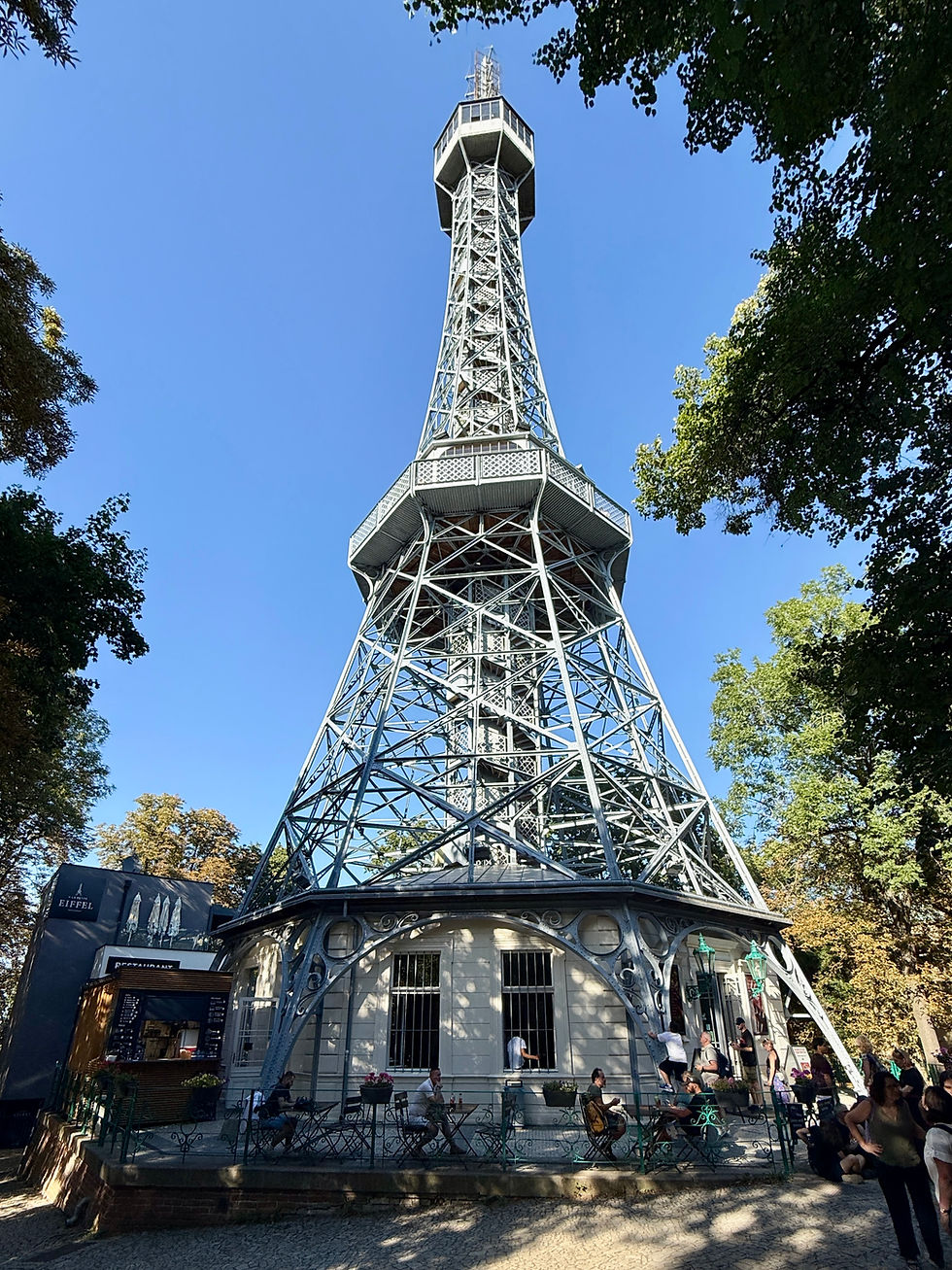
In the afternoon, make your way towards Petřín Hill.
The steel lookout tower was built at the end of the nineteenth century after a group of Prague visitors returned from the World Exhibition in Paris. Unsurprisingly, it resembles a smaller version of the Eiffel Tower.
The tower itself is around sixty metres high, but because it stands on top of Petřín Hill, the views over the city are spectacular.
If you have the energy, climb the 299 steps to the top.
Right next door is the Mirror Maze.
It may sound like an attraction aimed mainly at children, but we found the combination of mirrors and old-fashioned distortion mirrors surprisingly entertaining.
Dinner with atmosphere
There are several good options for dinner nearby.
Café Savoy is one of the best choices if you love historic grand cafés.
Beneath its spectacular neo-Renaissance ceiling, it feels as though time has slowed down.
We tried schnitzel with potato salad and steak tartare, prepared at the table.
Book ahead, because Café Savoy is very popular.
Day 3: Kampa, Karlín and Prague from the water
On the third day, leave some of the major landmarks behind and discover a more relaxed side of Prague.
Walk around Kampa-eiland
Beneath Charles Bridge lies Kampa, a small island that almost feels like a village within the city.
Walk along the water, through the small parks and towards Museum Kampa.
In front of the museum, three huge bronze babies by Czech artist David Černý crawl across the grass. You can see the same faceless babies climbing the Žižkov Television Tower elsewhere in the city.
Not far away is the famous Lennon Wall.
The wall has changed many times over the years and may feel less authentic than it once did, but it remains an iconic stop while exploring this part of Prague.
Discover Karlín
Next, take the metro to Karlín.
If you only stay in Staré Město and Malá Strana, you only see one side of Prague.
Karlín was once a working-class and industrial district and was badly affected by the floods of 2002. In the years that followed, it evolved into one of Prague’s most dynamic neighbourhoods.
Today, you will find trendy restaurants, coffee bars, design shops, renovated industrial buildings and far fewer tourists.
One of the most striking features is the Negrelli Viaduct, a nineteenth-century railway viaduct whose arches have gradually been given new uses.
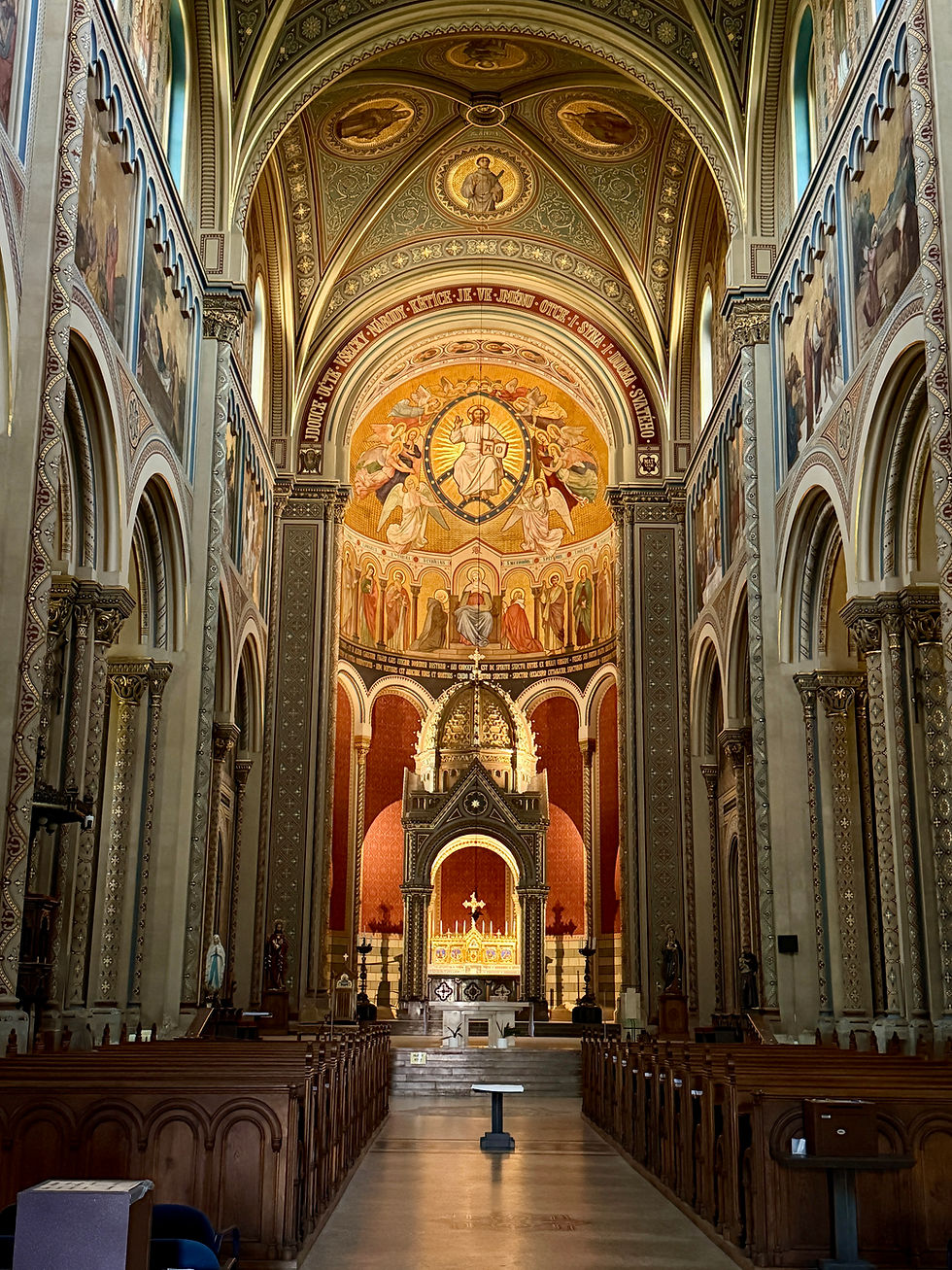
The impressive Church of Saints Cyril and Methodius is another landmark worth seeing.
Have lunch in Karlín
For lunch, we would choose Spojka Karlín.
Lots of greenery, an open kitchen and a relaxed atmosphere make it a great place to stop.
Another interesting option is Eska, known for sourdough bread, fermentation and seasonal ingredients.
For something more refined, consider Taro, where Vietnamese flavours are presented in a contemporary fine-dining setting.
Take a boat trip on the Vltava

Save part of your final afternoon to see Prague from the water.
Several small boats depart from beneath Charles Bridge for cruises along the Vltava and through the narrow Čertovka canal.
It may be a classic tourist experience, but in our opinion it is absolutely worth doing.
From the water, Prague looks completely different: the castle rises above the rooftops, historic façades line the riverbanks and the enormous piers of Charles Bridge become much more impressive.
You can also see the wooden structures protecting the bridge piers. These were originally designed to help break up ice when the Vltava froze during severe winters.
A late-afternoon cruise is especially beautiful, when the light softens and the city slowly begins to glow.
What to do in Prague if you have more than 3 days
If you have four days or longer, you can spread the itinerary out more slowly or add a few lesser-known places.
Crucifix Bastion (U Božích muk)
For an unusual viewpoint, head to Crucifix Bastion, a historic defensive wall built on medieval fortifications.
From here, you can look out towards Vyšehrad, Petřín and Nusle Bridge.
Folimanka Bunker
Even more unusual is Kryt Folimanka, a Cold War bunker built beneath a public park between 1952 and 1962.
The bunker lies around twenty metres underground and was designed to shelter more than a thousand people for a limited period.
It can be visited on selected days.
The contrast is remarkable: children play in the park above while a huge Cold War relic lies hidden underneath.
For more ideas, check www.visitczechia.com
Where to eat in Prague?
Prague’s food scene is much more interesting than the old clichés of cheap beer, goulash and pork knuckle might suggest.
Today, you will find modern Czech restaurants, international cuisine, stylish bakeries and historic grand cafés. Here are our favourite places:
Mlýnec
For a romantic dinner, we would recommend Mlýnec.
The restaurant sits right at the foot of Charles Bridge and combines modern cuisine with an exceptional location beside the Vltava.
We enjoyed dishes including salmon tartare, scallop ceviche and duck.
If the weather is good, ask for a table by the window or on the terrace.
Next Door by Imperial
At Next Door by Imperial, created by well-known Czech chef Zdeněk Pohlreich, you can look straight into the open kitchen.
The menu combines Czech classics with more contemporary dishes.
The atmosphere is stylish without feeling overly formal.
Café Savoy
Café Savoy remains one of Prague’s most atmospheric addresses for lovers of historic interiors.
The impressive ceiling, patisserie and classic dishes make it a good choice for breakfast, lunch or dinner.
Art Restaurant Mánes
Art Restaurant Mánes occupies a striking Functionalist building from the 1930s, partly built over the water.
The setting alone makes it memorable.
We enjoyed dishes including pike-perch, steak and a refined dessert finished at the table.
Cukrárna Myšák
For something sweet, head to Cukrárna Myšák, a historic pastry shop dating back to 1911.
Try a věneček, a ring of choux pastry filled with vanilla cream and topped with caramel icing.
And one more tip: the trdelník sold all over the city may look good on Instagram, but it is not a traditional Prague speciality.
Where to stay in Prague?
Mosaic House Design Hotel
We would recommend Mosaic House Design Hotel to travellers looking for a stylish hotel within walking distance of the centre, but away from the busiest tourist streets.
The hotel occupies a Functionalist building from 1934 and has a warm, almost residential feel.
Large bookshelves, comfortable seating areas and a peaceful courtyard make the lobby feel more like a stylish living room than a conventional hotel.
There is also a spa, and some rooms have rooftop terraces.
The Dancing House and the Vltava are only a few minutes away on foot.
Mánes Boutique Hotel

Nearby, Mánes Boutique Hotel, belongs to the same hotel group.
It is smaller and quieter, with spacious rooms and junior suites.
A good choice if you want to stay centrally but prefer a more intimate atmosphere.
What to do in Prague in every season
One of the reasons we enjoy Prague so much is that the city changes character with every season.
Prague in spring
From April to June, parks and gardens are in bloom and temperatures are usually pleasant.
It is an ideal time for walking, viewpoints and outdoor terraces.
Prague in summer
July and August are lively, but also the busiest months.
The Vltava riverbanks come alive in the evening, there are festivals and open-air events, and the days are long.
Visit the most popular attractions early in the morning.
Prague in autumn
September and October are among our favourite months.
The light becomes softer, the rooftops glow golden in the afternoon and there are usually fewer visitors than in summer.
Prague in winter
November to March has its own charm.
In December, Christmas markets, mulled wine and thousands of lights create a festive atmosphere. With a bit of luck, you may even see snow on Charles Bridge and the rooftops of Malá Strana.
And when it gets really cold, Prague has no shortage of museums, historic cafés and restaurants to warm up in.
Practical tips for visiting Prague
How to get to Prague from Belgium or the Netherlands?
By night train
We travelled with European Sleeper, which connects Brussel, Antwerpen, Rotterdam en Amsterdam directly with Prague.
You leave in the evening and arrive at Praha hlavní nádraží the following morning.
Don’t expect a luxury designer train, but waking up while travelling through Central Europe and arriving right in the city centre makes the journey part of the experience.
Always check the latest operating days before booking.
By plane
There are direct flights from Brussels Airport, Schiphol and Eindhoven to Václav Havel Airport Prague.
From the airport, you can continue into the city by public transport or Airport Express.
Getting around Prague
Prague has an excellent network of metro, tram and bus services.
For visitors, trams are especially useful.
Tram 22 is ideal for reaching Prague Castle and also doubles as a scenic ride through the city.
The official PID Lítačka-app is useful for both route planning and tickets.
Is the Prague Visitor Pass worth it?
That depends on your itinerary.
If you plan to visit several paid attractions in a short period, including Prague Castle, towers and museums, the official Prague Visitor Pass can be worthwhile.
If you mainly want to walk, explore neighbourhoods and visit only a few attractions, individual tickets may be cheaper.
It is worth calculating the cost based on what you genuinely plan to visit.
Prague has everything you might expect from a classic European city break: monumental squares, church spires, castles and one of Europe’s most famous historic bridges.
But what stayed with us most were the contrasts.
In the morning, you can stand almost alone on Charles Bridge. A few hours later, you may be wandering through a Baroque palace or centuries-old synagogue, and in the evening you can sit beside the Vltava looking at the same skyline you admired from above earlier that day.
Three days are enough to discover the highlights, but also just long enough to realise how much is still left to explore.
And perhaps that is one of Prague’s greatest charms.
There is always another reason to come back.


Comments